Sunday, 28 April 2013

Another home page

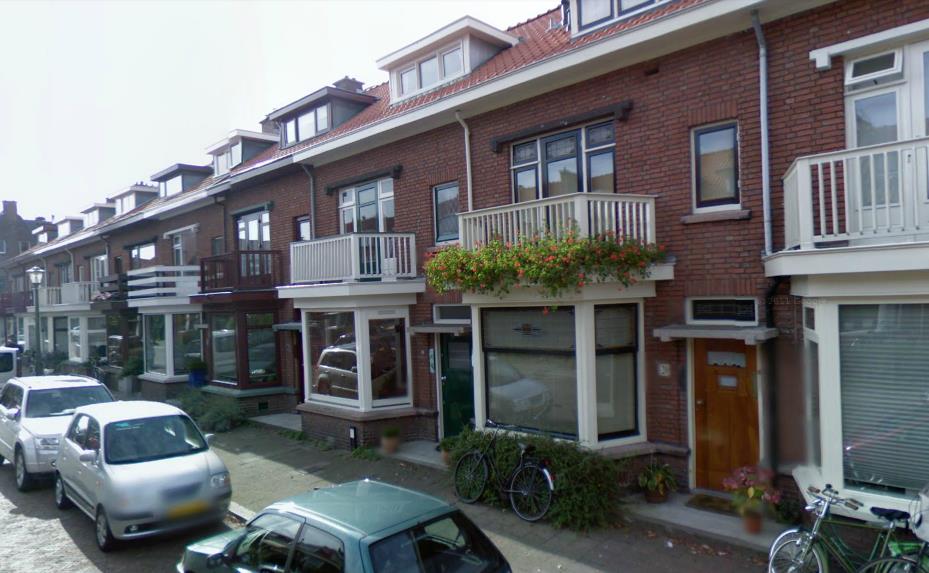
In the first post on this subject, Home! Sweet Home!, I told you about my motivation to show all the houses I ever lived in. In short, if I don't record my personal history my great great grandchildren certainly can't find it. The last house I told you about in the second post, was the one in The Hague-Loosduinen. It was also the last house where I lived before I got married. After our wedding party we moved to the neighboring city of Rijswijk, to the house where our son was born in 1967. Rijswijk is also the city where my mother was born. So you could say it was kind of coming home again. We lived there from October 29, 1965 to some time in June 1967.
Huis te Landelaan Rijswijk
526 Huis te Landelaan, Rijswijk (ZH)
It is the apartment on the first floor, right in the middle of the picture. It has the brown planters. Shortly before we moved there, I joined KLM Royal Dutch Airlines in The Hague. But some time in 1966 they moved their HQ from the Plesmanweg to Schiphol Airport. So we started looking for a house in that vicinity. But before going there we spent a few months in the house of my parents-in-law in Loosduinen. That was from June to August 15, 1967.
Pisuissestraat Den Haag Loosduinen
88 Pisuissestraat, Den Haag-Loosduinen
This street is also pictured in the previous post. But I took this picture almost 50 years later, the changes are evident. 
Rembrandtweg Amstelveen
372 Rembrandtweg, Amstelveen
On August 15, 1967 we moved to Amstelveen situated just a few miles east of Schiphol. KLM was very instrumental in finding this house. It was a socalled maisonnette consisting of two floors. The lower floor (with the purple windows) was situated on the corner, right above the red car. Our daughter was born there in 1970. We lived there very happily until February 1, 1988 when we bought a house elsewhere in Amstelveen. That made this house the last one we rented. And in the beginning in 1967 it was not a cheap house. I remember that the rent amounted to over 35% of my salary then. But that was Amstelveen for you. Its image then was that of a very prosperous village, the cause probably being the circumstance that KLM pilots were all living there. But by that time that was already history. However, while the crews had moved elsewhere, the price levels were there to stay...
Photo dates
Huis te Landelaan, Sep. 5, 2011
Pisuissestraat, Aug. 24, 2011
Rembrandtweg, Sep. 10, 2011

Saturday, 20 April 2013

More homely houses

Watersnoodramp 1953
Houses damaged by the 1953 flood
Last week I started this series about all the houses I ever lived in. It started with the house where I was born in 1944. The last one shown then, in fact it was number 6, brought us to 1953. That was the year large parts of southwest Netherlands were flooded. As a consequence thereof close to 2,000 people died during the night of February 1, 1953. During the morning of that very same day my mother told me that I would be living with a family in a place called Huizen. It is situated on the borders of the IJsselmeer in the middle of the country. 
Nieuw Bussumerweg Huizen
133 Nieuw Bussumerweg, Huizen
I lived there for about a year from August 1953 to September 1954. It was a fairly large house but so was the G. family living there. It consisted of 4 boys, 3 girls and their parents of course. I remember I had a great time there but after a year my stay came to an end.
Mimosastraat Den Haag
46 Mimosastraat, Den Haag
We are still talking about the period less than ten years after WW2. The housing situation in Holland was such that it was quite common for two families to share a single house. And for us this situation was no different. So my mother obtained a floor in a house owned by acquaintances, Mr. and Mrs.  Van W-D. van L. The house was situated in the part of The Hague called Bohemen. It was just a ten minute bike ride away from coastal Kijkduin where my father and grandparents lived before the war. The Mimosastraat house was our residence between September 1954 and early 1958. It is the house in the middle with the two lamps switched on. We lived on the second floor.
Tramstraat Loosduinen
10 Tramstraat, Den Haag-Loosduinen
And then finally, 13 years after the war, my mother managed to get a house all to herself and to her two sons. Again this house was very close to Kijkduin and the North Sea beach. It was situated in the former village of Loosduinen, now part of The Hague. We lived in the house with the white curtains on the second floor from early 1958 until September 1963.
For me this was a very happy move because here I met the girl who is still my wife today. That memorable event took place during the first half of 1959. 
Pisuissestraat Den Haag
124 Pisuissestraat, Den Haag-Loosduinen
In 1963 new apartments were built just around the corner from where we lived. This opportunity was too good to be true, a new house with an acceptable rent! So we moved again. Our house is in the block to the very left and just out of sight. I lived there until the day I married on October 29, 1965. Until that same date my future bride lived  in the block that is pictured so prominently here. Her parents lived on the first floor to the very right. Together we moved to the neighboring city of Rijswijk.
Photo credits
'Damaged houses' taken from Wikipedia
'Pisuissestraat' has been scanned from a picture postcard I have
The color pictures have been taken by myself on April 11, 2012, Jan. 18, 2012 and Feb. 22, 2007 resp.

Saturday, 13 April 2013

Home! Sweet Home!

Digging in the past may be regarded as the genealogist's core business. The older the document or the source, the better. But generally genealogists tend to forget that recording contemporary data is equally important. If you want to enable your great grandson to find out all kinds of interesting details about his great grandparents, you have to enable him to do so. In other words we have to write down our own, contemporary history. And history not only consists of stories, also material objects such as cars and houses are part of that. Therefore, in this blog I have already paid attention to e.g. the aircraft types I flew in during my professional life and the cars we owned as a family. Now I like to highlight the houses that we lived in. I'll start with my birth home and after having completed all the houses (my wife and) I lived in, there will be posts showing my wife's domiciles.
OK, here we go, back to The Hague in 1944.
661 Laan van Meerdervoort, The Hague
During WW2 there was a maternity hospital in this house. It was named Huize Margaretha (Margaretha's home). According to stories of my mother it was not a paragon of hygiene. I stayed there from Jan. 25 to approx Feb. 5, 1944. Shortly after I developed chicken-pox, a desease you are only entitled to when you are at least about 1,5-2 years old.
18 Mispelstraat, The Hague
After 10 days or so I moved to the nearby house of my grandparents. Although my father and mother lived in Apeldoorn at the time, my mother decided to have me in The Hague. We stayed there from approx Feb. 5 until some time after Mar. 26, 1944. Number 18 is the house with the horizontal brace drawn underneath it. The handwriting is my grandmother's.
6 Parkweg, Apeldoorn
The Parkweg is currently named Prof. Röntgenstraat
My father was a civil servant working for the Home Office. Earlier during the war the Germans ordered this government body, together with the Ministry of Justice, to be transferred from The Hague to Apeldoorn in the eastern part of the country. We lived in the house of two elderly ladies named Bakker. My stay there lasted from some time after Mar. 26, 1944 to the end of June 1945 when my mother and I moved back to The Hague.
18 Mispelstraat, The Hague
As a consequence of the war there was a large shortage of houses. So initially there was hardly any other possibility but to live with my grandparents again. Taking into consideration the circumstances I am sure that they did not mind this at all, to the contrary! We lived there from June 1945 until sometime prior to Sep. 27, 1946 when we were assigned a house in the Goudreinetstraat.
614 Goudreinetstraat, The Hague
Our house was the second ground floor house from the left, just after the portico. For reasons unknown to me, we went back to my grandparents house in the Mispelstraat around August 1949. So we stayed there close to 3 years. The Goudreinetstraat house was then taken by my father's sister and her family. They lived in with my grandparents from Sep. 27, 1946 until approx 1,5 year later. No doubt all this moving back and forth had to do with difficult housing situation at the time.
18 Mispelstraat, The Hague (green front door)


This time I spent some 4 years on this address, the house of my grandparents. I remember my grandmother telling us that they bought this house prior to WW2 for the impressive sum of 5,000 Dutch Guilders. Converted to euro's that was approx € 2,250 then and some € 46,000 today. Measured by today's standards, that was a cheap house. Current prices for similar houses in that part of The Hague are in the range of € 300,000. Speaking of a bubble...

Photo credits
Home Sweet Home www.pandurohobby.de
Laan van Meerdervoort Google
Mispelstraat (1): blogger collection
Parkweg: blogger picture Sep. 23, 2011
Mispelstraat (2) Beeldbank, Den Haag
Goudreinetstraat Beeldbank, Den Haag
Mispelstraat (3) Google

Saturday, 6 April 2013

Pedigree chart/kwartierstaat

Voor een Nederlandse samenvatting, zie na de Engelse tekst.
This post is not meant to show you the details of where and when my ancestors have been born etc. The idea is that I show you the pedigree chart that my genealogy software is able to produce. I am  using a Dutch software package called GensDataPro. It has been developed by the Dutch Genealogical Society (NGV). Currently it is priced at € 70.00 for non members. It is not cheap but it is very flexible and the after sales service is fine.
pedigree chart
7 generations 145 degrees print
The chart that you see here shows seven generations. It may be extended to maximum ten generations. But then the ninth and tenth generation are hardly legible if printed on letter or A4 format. Apart from color print black and white print in various qualities is possible as well. 
In the picture above the angle of the "bottom line" is 145 degrees but it can also be printed as full circle (0 degrees).
kwartierstaat
7 generations full circle print
It is also possible to show the pedigree chart (or any other genealogical printout) in rectangular frames. Below you see just a part of such a print, a decendants chart. Obviously printing a full chart on letter or A4 format will not result in a legible print. It is also possible to add thumbnails to each of the frames.
parenteel decendants chart
Decendants chart with thumbnails
I hope this post serves a useful purpose e.g. when making comparisons with other software. To avoid any misunderstanding I am in no way connected to the makers of GensDataPro nor am I a member of the NGV. The above is shown for information purposes only.

Samenvatting
Deze blogpost heeft niet tot doel om u de details van mijn kwartierstaat te tonen. De bedoeling is om te laten zien welke mogelijkheden het programma GensDataPro heeft om die kwartierstaat grafisch weer te geven. Het programma is ontwikkeld door de Nederlandse Genealogische Vereniging (NGV) en kost € 70,00 voor niet-leden en een tientje minder voor leden. Het is zeker niet het goedkoopste programma maar het werkt prima, heeft zeer veel mogelijkheden en er is een goede helpdesk.
Het eerste plaatje laat een cirkeldiagram zien met 7 generaties. Prints tot 10 generaties zijn mogelijk maar dat gaat wel ten koste van de leesbaarheid van generaties 9 en 10. Tenminste, wanneer er op A4-formaat wordt afgedrukt. Naast kleur zijn ook zwart/wit prints mogelijk.
Het afgebeelde diagram heeft een "onderlijn" met een hoek van 145 graden. Die hoek is instelbaar en kan ook op 0 graden gezet worden waardoor er een echt cirkeldiagram ontstaat. Zie het tweede plaatje. Nadeel daarvan is wel dat de namen deels op z'n kop staan.
Kwartierstaten, genealogieën en parentelen kunnen ook worden weergegeven zoals in het derde plaatje wordt getoond. Het zal duidelijk zijn dat een afdruk van b.v. een beetje kwartierstaat op A4-formaat, nauwelijks leesbaar is. Maar afdrukken op meerdere bladzijden is natuurlijk ook mogelijk. En dan is het wel leuk dat ook z.g. thumbnails kunnen worden toegevoegd. 
Hopelijk hebt u iets aan deze informatie, b.v. wanneer u vergelijkingen maakt met andere genealogische pakketten.
Voor de goede orde, ik heb geen enkele binding met GensDataPro noch ben ik lid van de NGV. 

Sunday, 31 March 2013

My coat of arms

Well, let me rephrase that. It is not my coat of arms, it belongs to the family of my maternal grandmother, Antje Doelman (1892-1984). Her ancestors can be traced back a long way. If we follow a straight line for nine generations, we meet granny's ancestor Frans Cornelisse Doelman. I presume he was born around 1650. Frans was not an unimportant man. He lived in the village of Maasland near Rotterdam. It is quite possible that he was a farmer but he was also holding the position of alderman, deacon and, on behalf of the community, he was taking care of the funds destined to support the poor (armmeester). It was not unusual for people of his status to have a coat of arms*.
Whether he was the first Doelman to have this coat of arms is doubtful. There are earlier records showing a similar coat of arms. It belonged to a Cornelis Michielsz Doelman, alderman until 1566. It is unknown how Frans is related to this Cornelis.
In 1658 a farm was built in Maasland. Ever since the early 19th century this farm was known as the Doelman's farm (Doelmanshoeve). In this farm there was, and still is a stained glass window showing a Doelman coat of arms (right). There is a great resemblance to the one shown above. The farm still exists but now as a restaurant called the De Ridderhof (The Knight's Court).
In the Armorial Général, the very impressive heraldic work by J.B. Rietstap, the Doelman coat of arms is described as you can see below.
Excerpt from the Armorial Général
The full French text reads: Doelman - Hollande D'argent au lion d'azur, armé et lampassé du champ. In English that is: Doelman - Holland Of silver (white) with lions in azure (blue), armed and langued gules.
I am not sure that this description fits both coat of arms shown in this post. I am not even certain what it means...
When the last owner of the Doelman's farm died on Dec. 4, 1916, he was buried in Maasland. His name was Adrianus Doelman and he lived to be 79 years old. It is said that his coat of arms is part of his tombstone. So I better go there before weathering makes it impossible to see how it looks like. But I trust that also there the man's face at the top of the coat of arms resembles the face of a Doelman. Because that's what Granny told me. And if ever there was a truthful woman, it was Granny!

*Contrary to popular belief a coat of arms does not automatically imply nobility. But rest assured, even today it is possible to design a coat of arms for your family and have it registered. In the Netherlands registration is possible via the services of the Central Bureau of Genealogy (CBG) or the Dutch Genealogical Society (NGV).

Sunday, 24 March 2013

My surname could have been...

Meuwis
The patronymic Meuwis
still exists in Hasselt
Voor een samenvatting in het Nederlands, zie na de Engelse tekst.
In The Netherlands the name Miebies is not regarded as, how shall I say, as being typically Dutch. Whenever I meet people for the first time the least they say is that they never heard it before. There are also people pronouncing Miebies as Miebiesch, giving it a kind of German twist. Speaking of the pronunciation of my name, I should tell English speakers that it is pronounced as Meebees. 
In an earlier post I explained what the origin of my surname is. The man I regard as the ancestor of all Dutch Miebieses came from Kuringen, also called Curingen or Curange in French. It is situated in what is now the Belgian province of Limburg. The neighboring city of Hasselt absorbed Kuringen in 1977. When Frederikus Miebies (1760-1834) came to The Hague in approx 1790 his last name was still Muwis. (When Frederikus got married in 1795 the name was written as Miebis.)
Bartholomew Tiepolo
The Martyrdom of Bartholomew
by 
Tiepolo
In Kuringen, Hasselt and in more towns and villages in Limburg, Muwis and related names are quite common. The reason of this name being wide spread is that it is a patronymic. It is a derivation of Meeus which is short for Bartholomeus (or Bartholomew in English). 
But apart from Meeus there are many more variations. Back in 2004 I made an analysis of the number of patronymics related to Bartholomeus the disciple. I limited myself to the following sources from the State Archive in Hasselt.
Kuringen                         Hasselt
Baptism, book 81-2       book 50-8 & book 12
Marriage, book 81-4     book 9 & book 5
Death, book 81-6           book 6
I received extracts of these books from a genealogical acquaintance in Limburg (M.M.). It will be clear that using the BMD-registers all at the same time, causes double/triple records of the same person. So please keep that in mind when looking at the numbers. 
Distribution of M...-patronymics over a period of 300 years
Please click to enlarge
As you can see in the above table, there are some 30 variations of the name. There is a significant peak in the number of families carrying these M...-patronymics. During the 18th century most surnames have been recorded in the a.m. books. Whether this sudden popularity had a specific reason I don't know. I have been unable to trace any specific events related to the disciple Bartholomew other than the rebuilding after a fire of the not too distant Bartholomew basilica in Meerssen in 1749.
In any case my last name could easily have been Me(e)uwis, Meuwis(sen), Mievis or any other derivation of the name of the disciple. And depending on how Flemish Fredericus would have pronounced that name in The Hague and how it was subsequently understood and noted by the clergyman there, it could have been quite different from the present day name of Miebies. It also demonstrates my thesis that the combination of local speech and the lack of a hearing aid can be detrimental to one's last name :)

Samenvatting
In Nederland is Miebies nou niet bepaald een veel voorkomende naam. Vaak informeren mensen waar die naam toch vandaan komt. Men vermoedt vaak een Duitse herkomst, hetgeen in Nederland niet zo vreemd is. Ik heb al eens uitgelegd wat de herkomst van de naam is en dat die uit Kuringen bij Hasselt in Belgisch Limburg komt. Toen onze stamvader Fredericus Miebies (1760-1834) omstreeks 1790 naar Den Haag kwam, was zijn achternaam Muwis. (In zijn huwelijksakte in 1795, wordt de naam geschreven als Miebis.)
In Kuringen, Hasselt en omgeving is de naam Muwis, en soortgelijke namen, veel voorkomend. Dat is niet onlogisch omdat de naam een patroniem is en afgeleid van de apostel Bartholomeüs. Muwis is dan weer een afgeleide van (Bartholo)Meeus. Maar naast Meeus zijn er meer afgeleide namen, veel meer. In 2004 heb ik daar eens een overzichtje van gemaakt en het zijn er zeker een stuk of 30, zie de tabel hierboven. Met name in de 18e eeuw kwamen die namen veel voor. Waarom? Geen idee. Ik heb geen lokale gebeurtenissen kunnen vinden die als oorzaak aangemerkt kunnen worden. Alleen de wederopbouw van de Sint Bartholomeüsbasiliek in het enigszins nabij gelegen Meerssen zou dat kunnen zijn. Maar dat was pas in 1749.
Maar hoe je het ook wendt of keert, i.p.v. Muwis had de naam ook Me(e)uwis, Meuwis(sen), Mievis of elke andere afleiding van de naam van de discipel kunnen zijn. En afhankelijk van het simpele gegeven hoe Fredericus zijn naam in Den Haag heeft uitgesproken en hoe de geestelijke het daar heeft verstaan en opgeschreven, had onze achternaam heel anders kunnen zijn. Hetgeen maar weer eens bewijst dat de combinatie van een dialect en een ontbrekend gehoorapparaat een fnuikende invloed op iemands achternaam kan hebben :)

Photo credit:
Giovanni Battista Tiepolo [Public domain], from Wikimedia Commons

Saturday, 16 March 2013

Hello Bandoeng

Willy Derby Hallo Bandoeng 1929
The post title is the here well known beginning of a 1929 song written by Dutch singer Willy Derby. I am not sure it is still well known today but it certainly was when present day Indonesia was a Dutch colony: the Dutch East Indies (DEI). 
The rather sentimental song is about a mother in Holland calling her dearly missed son in Bandoeng, a large city on the island of Java and over 15,000 kilometers away. In 1979/1980 Soerabaja (also situated on Java) born singer Wieteke van Dort was responsible for a revival of the song. 
In those days making a phone call was an arduous undertaking. I remember when my grandparents wanted to make a call to their daughter in the DEI, a PTT-van* with a transmitter came to their house in The Hague. It was then "flooded" with all kinds of kinds of cables, wires and phones and after hours of preparation the call came into being. I am talking around 1950 now.
This was not the first time for them to communicate with members of the family 
Meinsje Doelman Balikpapan
Meinsje Doelman in
Balikpapan (DEI)
in the DEI. My grandmother Antje de Langen-Doelman (1892-1984) had a younger brother and sister who both lived in the East Indies long before WW2. Her sister was Meinsje (Mies) Doelman (1900-1973). She was married to Jan (Bob) Wemmers (1898-1976). He was employed by oil company Shell and a.o. they lived in Balikpapan on the island of Borneo. During WW2 Jan was interned by the Japanese in one of their not so nice camps. His stay there was registered on the card below. Prior to his internment the couple lived in 22 Sawohlaan, Batavia. Later he was transported from the camp to Burma where he was forced to work on the infamous Burma -Thailand railroad. You may remember the movie called Bridge on the River Kwai a.o. starring Sir Alec Guinness and William Holden. Jan survived the railroad but if I remember well, his health was affected.
Interneringskaart Jan Wemmers
Japanese camp registration of Jan Wemmers
The brother, Cornelis Doelman (1895-1983), lived in Batavia (currently Jakarta), capital of the DEI. He was a supervisor of poly technical educational institutions in the East Indies. His Belgium born wife Lea Eulalia Hortensia Libert (1896-1983) was with him ever since they moved there after their marriage in 1921.
During the very early stages of WW2 it was possible to send letters from Holland to the DEI. I have one written by Pieter Doelman (1864-1942). He was the father of Antje, Cornelis and Meinsje. At the time he lived in Antje's house on 18 Mispelstraat, The Hague. On May 30, 1940 he wrote about the surrender of Holland and Belgium and about the bombing of Rotterdam ("26,000 houses destroyed"). Also about a relative who was killed in action during the German invasion.  
But apparently the possibility to communicate by mail was stopped a few months
Red Cross message form 1940
Red Cross message form
later. That is no surprise as obviously the Germans did not allow any connections by air nor by ship. However, there was still the Red Cross. They provided a kind of Short Message Service avant la lettre. There was a maximum of 25 words. On this form Cornelis informs his father in Holland that the DEI family is okay. The date is Oct. 17, 1940. At the time Cornelis is living in 31 Sawohlaan, Batavia, the same street where his sister Meinsje and her husband lived or had been living. The back of this form was used for the return message. The reply was dated Jan. 7, 1941 suggesting a transportation time for these forms of more than 75 days.
Today we live in a world of almost instant communication possibilities anywhere. We have our mobile/cell phones enabling us to call, to WhatsApp, to ping, to SMS and what have you. And in case you are out of reach of 3G and even 4G networks, there is always the satellite phone. For youngsters such as our grandchildren it may be good to know that it wasn't always like this. People wrote letters that took a month or more to reach their destination. People did not have phones in their homes, one had to go to the Post Office to place a call to a neighboring city. International calls? Call the international operator please; they would return the call when the connection was made. All these changes came about in the course of the last 60, 70 years. But it is good to realize that the world wasn't always as near and as small as it is today.


*PTT is short for Post, Telephone and Telegraph, the governmental provider of all these services.

LinkWithin

Related Posts Plugin for WordPress, Blogger...